Administrative hours: 8:00 a.m. – 5:00 p.m. CST, 7 days a week · Therapy sessions available until 9 p.m. CST
Imago couples therapy
Couples Therapy in San Antonio
You love each other, so why does your relationship feel so hard? Imago couples therapy helps partners step out of painful patterns, truly hear each other and reconnect.
- Certified Imago therapist
- In person & telehealth
- Evenings until 9 p.m.

You don’t have to keep having the same fightImago Relationship Therapy
Overview
Have you ever wondered how two people who love each other so deeply can end up feeling like strangers? You can share a home, raise children, manage finances, sleep in the same bed, and still feel miles apart emotionally. You may talk every day, but somehow you no longer feel heard. You may resolve an argument only to find yourselves having the exact same fight a week later.
Perhaps one of you wants to talk everything through, while the other needs space. One partner reaches for reassurance, and the other pulls away. One feels criticized; the other feels ignored. Before long, a conversation about the dishes becomes a debate about respect, a disagreement about money becomes a question of trust, and a simple request for affection turns into another painful rejection.
If this sounds familiar, you are not alone. And it does not automatically mean you chose the wrong person. Sometimes the problem is not that you have stopped loving each other. It is that you have become caught in patterns that make it difficult to experience that love. This is where Imago Relationship Therapy offers couples a different way forward.
When the same argument keeps showing up in your marriage
Most couples do not begin their relationships expecting to feel lonely beside the person they love most. In the beginning, differences can feel exciting. You are curious about each other, eager to understand one another, and willing to overlook things that might later become sources of frustration.
But life happens. Work becomes demanding. Children arrive. Financial pressure increases. Intimacy changes. Old wounds get activated. The small habits you once found endearing may suddenly irritate you, and the person who once made you feel safe may become the person whose words hurt you the most.
A familiar scenario
- “You never listen to me.”A wife tells her husband how she feels. He immediately feels accused. He works hard for their family and believes his efforts show how much he cares, so he responds by explaining everything he has done that week.
- She feels dismissedShe hears his explanation as another dismissal of her feelings, and becomes louder because she feels unheard.
- He feels it’s never enoughHe hears her continued frustration as proof that nothing he does will ever be enough, and becomes quieter because he feels attacked.
- Someone walks awayEventually one of them leaves the conversation, and the other is left feeling abandoned. The original issue never gets resolved.
Instead, both partners leave the conversation with more evidence for the story they already believe: “I don’t matter to you.” This is how communication problems in marriage become deeply entrenched. Couples may spend years arguing about the surface issue without understanding the hurt, fear or unmet need underneath it.
The real question is not simply, “How do we stop fighting?” It is, “How do we understand what happens between us when we feel hurt?” That distinction matters.
What is Imago Relationship Therapy?
Imago Relationship Therapy is a relationship-focused approach developed by Harville Hendrix and Helen LaKelly Hunt. It helps couples understand how their personal histories, emotional needs and habitual ways of relating can influence their relationships in adulthood.
The word Imago refers to an unconscious image, or collection of expectations, about love and relationships that can be shaped by early experiences. Our childhood experiences influence what feels familiar, safe, threatening or comforting to us. They do not determine our future, but they can influence how we respond to intimacy, conflict, rejection and emotional vulnerability.
- Feeling overlookedSomeone who grew up feeling overlooked may be especially sensitive to a partner’s distraction.
- Learning to withdrawSomeone who learned that expressing emotions led to criticism may withdraw when a conversation becomes intense.
- Seeking reassuranceA person who experienced inconsistency may seek frequent reassurance, while a partner who learned to rely only on themselves may experience those requests as pressure.
Neither partner necessarily intends to hurt the other, yet their protective responses can collide. Imago Relationship Therapy helps couples explore these patterns while learning practical communication skills that encourage curiosity, empathy and emotional connection rather than blame and defensiveness.
The goal is not to determine which partner is the problem. It is to help both partners understand the pattern they are creating together and learn how to respond differently.
Why do we hurt the people we love the most?
One of the most frustrating parts of an intimate relationship is that the person who knows you best can sometimes hurt you most deeply. Your partner knows what makes you feel rejected, when you need reassurance, what causes you to shut down, and which words are likely to trigger a strong reaction. And you know the same things about them.
When conflict becomes repetitive, couples may begin using those vulnerabilities against each other, sometimes intentionally and sometimes without realizing the impact of their words. Imago invites couples to look beneath the immediate disagreement:
- Instead of “Why are you always so defensive?”A partner might begin to ask, “What happens for you when you feel criticized?”
- Instead of “You never care about my feelings”The conversation might become, “When you turn away while I’m talking, I feel alone, and I need to know that what I’m saying matters to you.”
These are not merely nicer ways to speak. They create opportunities for a different kind of conversation. One partner can begin to hear the pain underneath the complaint; the other can begin to recognize the fear underneath the withdrawal.
Understanding does not mean agreeing with everything your partner says. It does not erase the impact of hurtful behavior or require you to abandon your boundaries. It means becoming willing to understand your partner’s experience without immediately defending your own.
The Imago Dialogue: learning to hear instead of react
One of the central practices in Imago Relationship Therapy is the Imago Dialogue. It gives couples a structured way to communicate, so each person has an opportunity to speak, be heard and feel understood. The dialogue commonly involves three key practices:
- MirroringOne partner listens and reflects back what the other has said, rather than immediately preparing a rebuttal, offering a solution or explaining why the speaker is wrong.
- ValidationThe listening partner communicates that the speaker’s perspective makes sense within that person’s experience. Validation does not require agreement.
- EmpathyThe listening partner makes an effort to imagine the feelings the other person may be experiencing.
Imagine a husband saying, “I feel like I can’t do anything right around here.” Instead of responding, “That’s ridiculous. I never said that,” his wife might reflect what she heard and ask whether she understood him correctly. She might discover that he feels discouraged and fears disappointing her, and she can acknowledge that without denying her own frustrations. Likewise, he may learn that her repeated requests are not an attempt to control him; she may be longing to feel supported rather than responsible for everything.
The conversation begins to change because the goal is no longer to win. It becomes an opportunity to understand.
Of course, learning these skills takes practice. Couples who have developed years of painful communication habits should not expect one conversation to undo them, but a structured dialogue provides a starting point for building a different experience of connection.
Imago couples therapy for the couple who feels disconnected
Couples seek relationship counseling for many reasons. Some arrive after a major betrayal. Others have been arguing for years. Some struggle with intimacy, parenting disagreements, financial stress or a growing sense that they are living parallel lives. Others are not fighting much at all; they are simply no longer talking about anything meaningful.
One partner may spend evenings on a phone while the other watches television. Conversations revolve around schedules, groceries, children and responsibilities. Affection becomes less frequent, date nights feel forced, and when one person finally says, “We need to talk about our relationship,” the other may wonder where the problem came from. Emotional disconnection does not always announce itself through dramatic arguments. Sometimes it develops through countless small moments in which partners stop turning toward each other.
Imago Relationship Therapy can help couples recognize these patterns and begin rebuilding connection through intentional communication. It may be especially worth exploring if you:
- Keep having the same argument without reaching a lasting resolution
- Feel unheard, dismissed, criticized or misunderstood
- Have difficulty discussing sensitive subjects without becoming defensive
- Experience a pursuer-and-withdrawer pattern, where one partner pushes for connection and the other retreats
- Feel more like roommates or co-parents than romantic partners
- Want to rebuild emotional intimacy, trust or affection
- Love each other but are questioning whether your relationship can improve
- Want to strengthen your relationship before problems become more entrenched
You do not have to wait until your marriage is in crisis to seek help. Couples counseling can also be a proactive investment in communication, intimacy and long-term relationship health.
What does progress look like in Imago Relationship Therapy?
Healing in a relationship does not necessarily mean you will never disagree again. Two people can understand each other deeply and still have different preferences, needs, values and opinions. Progress may look more ordinary than you imagined:
- A disagreement that ends with understanding instead of days of silence
- Being able to say “That hurt me” without fearing the conversation will become a battle
- Recognizing that your partner’s withdrawal is a protective response rather than automatically reading it as a lack of love, while still addressing its impact
- Feeling comfortable enough to discuss intimacy, resentment or disappointment without immediately shutting down
Consider a couple who has spent years arguing about household responsibilities. One partner feels overwhelmed and unsupported; the other feels their contributions are constantly overlooked, and each keeps a mental record of what the other fails to do. Through guided conversations, they begin to recognize that the disagreement is connected to deeper needs: one wants to feel supported, while the other wants to feel appreciated rather than perpetually inadequate.
They still need to negotiate responsibilities. Insight alone will not load the dishwasher or create a fair division of labor. But understanding the emotional meaning attached to the conflict can help them approach the practical problem with less hostility and greater cooperation.
Understanding creates an opening for change, but lasting change also requires practice, accountability and consistent action.
No responsible therapist can guarantee a particular outcome. Progress depends on many factors, including the nature of the relationship difficulties, each partner’s willingness to participate, and whether the approach is appropriate for the couple’s circumstances. The aim is to help couples develop a more constructive way of relating, not to promise a perfect relationship.
Should you try couples therapy, an Imago workshop or a private intensive?
If you are looking for marriage counseling or relationship therapy, you may be wondering which option makes the most sense for your situation. There is no single right starting point for every couple.
- Work with an Imago relationship therapistOngoing couples therapy may be a good fit when you want personalized support with recurring conflict, communication problems, trust, emotional disconnection or relationship patterns that have developed over time. An Imago-trained therapist can help you explore your relationship dynamics, practice structured dialogue and work toward goals specific to your relationship. Look for a qualified therapist whose training, experience and approach fit your needs.
- Attend an Imago couples workshopWorkshops such as Getting the Love You Want introduce couples to Imago concepts and communication practices they can begin applying in everyday life. Rather than waiting for a conflict to occur in a therapy session, couples learn together and practice new skills in a dedicated environment. Workshops are educational experiences, however, and are not a substitute for individualized clinical care when significant relationship difficulties require it.
- Consider a private couples intensiveA private intensive offers a more concentrated period of work with a therapist, often over an extended session or multiple sessions scheduled close together. It may suit couples with demanding schedules or a desire to devote focused time to their relationship. Discuss your history, expectations and clinical needs with the provider beforehand: an intensive is not appropriate for every couple, and a longer session does not automatically mean faster or more lasting results.
If there is coercive control, intimidation or fear of retaliation within the relationship, seek an individual assessment with a qualified professional before pursuing joint relationship work. Safety must come first.
You do not have to keep having the same relationship
Maybe you have already tried talking more, arguing less, reading relationship books, taking vacations together, or promising that things will be different next time. Maybe you have wondered whether your partner understands you at all. Or perhaps you are the one searching for couples therapy because you are tired of feeling like the only person trying to save the relationship.
Before you conclude that nothing can change, consider whether you have had the opportunity to learn a different way of communicating. Love matters. Commitment matters. But neither automatically teaches two people how to navigate their differences, understand their emotional triggers, or repair the hurt that accumulates over time. Those are skills that can be learned and practiced.
We believe relationships deserve intentional care. You do not need to have all the answers before you begin; you simply need to be willing to explore a different way forward.
Ready to work on your relationship? We can help
Whether you are arguing about the same things, struggling to communicate, feeling emotionally disconnected or trying to rebuild trust, couples counseling can provide a space to understand what is happening between you and begin developing healthier ways of relating.
At Rhapsody Counseling & Wellness Center, we understand that relationship struggles are rarely as simple as the argument that brought you to counseling. Beneath frustration, silence, defensiveness or resentment, there may be hurt, unmet needs and patterns that neither partner knows how to change alone. Our goal is to help couples move beyond simply managing conflict toward greater understanding, communication and connection.
- Couples counseling at RhapsodyIf you are experiencing recurring conflict, communication difficulties, emotional disconnection or other relationship concerns, professional couples counseling may be the right starting point. Work with a qualified therapist to explore your patterns, identify your goals and decide what support best fits your needs.
- Imago workshops through our sister practiceTo learn practical tools for communicating and connecting, explore the Imago-based workshops offered through our sister practice, Authentic Beyond the Couch, a structured opportunity to practice a different way of listening and understanding one another.
- Private relationship intensives and coachingFor a more concentrated experience, Authentic Beyond the Couch may be a starting point for private intensives or relationship coaching. If you are experiencing significant distress or need individualized clinical care, we can help you consider whether couples therapy or another clinical service is more appropriate.
Explore Imago workshops & intensives at Authentic Beyond the Couch
Because you deserve more than another conversation that ends in frustration. You deserve the opportunity to understand one another differently.
Want something more focused?
Couples intensives & coaching with our sister practice
Ongoing couples therapy happens here at Rhapsody, with weekly sessions in Windcrest, Helotes or by telehealth. For focused, time-limited work like workshops, intensives and coaching, visit Authentic Beyond the Couch, our sister practice with the same values and leadership.
-
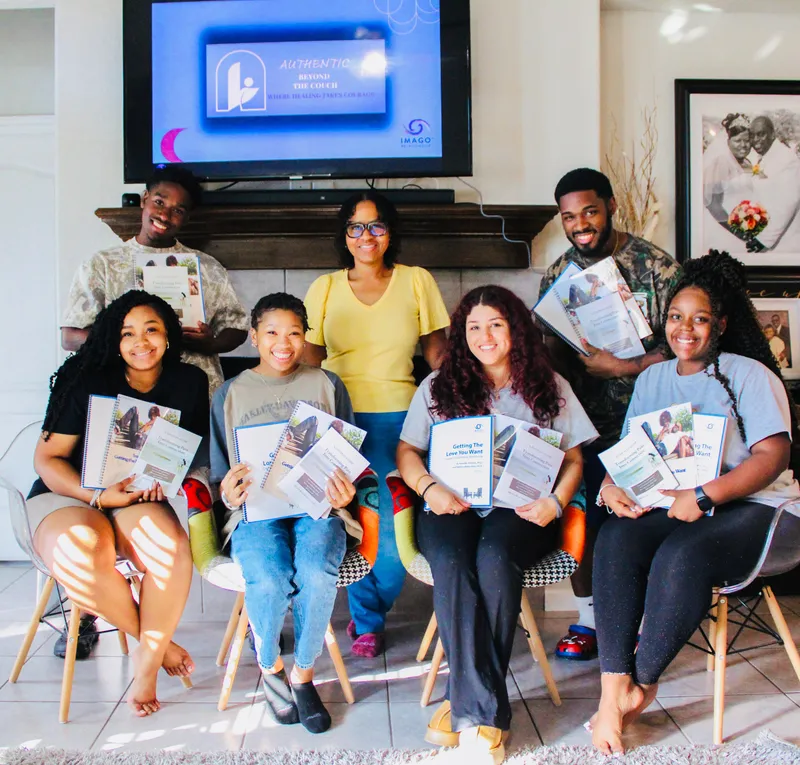
Workshop
Getting the Love You Want Couples Workshop
An Imago-based workshop for couples who want to understand each other’s needs, communicate with empathy and reconnect.
See workshop dates (opens in new tab) -

Coaching
Couples Coaching with Jirzia Blackman
Structured, goal-oriented Imago coaching for couples ready to break negative cycles and build lasting intimacy.
Explore couples coaching (opens in new tab)
Related services
Other ways we can help
Many concerns overlap. Your therapist will tailor your care to everything you are working through.
Marriage Counseling
Work through conflict and strengthen your commitment, whether you are struggling or simply want more.
Learn more about marriage counselingFamily Therapy
Improve communication, navigate transitions and help every member of your family feel heard.
Learn more about family therapyGroup Therapy
Heal alongside others who understand, in a supportive group led by a Rhapsody therapist.
Learn more about group therapyAnxiety Counseling
Learn practical ways to quiet racing thoughts, ease worry and feel more at home in your own body.
Learn more about anxiety counselingStress Counseling
Sort through work, family and life pressures, and build habits that help you recover and cope.
Learn more about stress counselingDepression Counseling
Steady, gentle support to lift the heaviness, reconnect with what matters and rebuild your energy.
Learn more about depression counseling
Making lives whole, one step at a time
Start couples counseling at Rhapsody
You do not have to figure out the next step on your own. Call us or send a request and we will match you and your partner with the right couples therapist, in person in Windcrest or Helotes, or by telehealth.
If you are in crisis or thinking about harming yourself, call or text 988 (Suicide & Crisis Lifeline) or call 911.